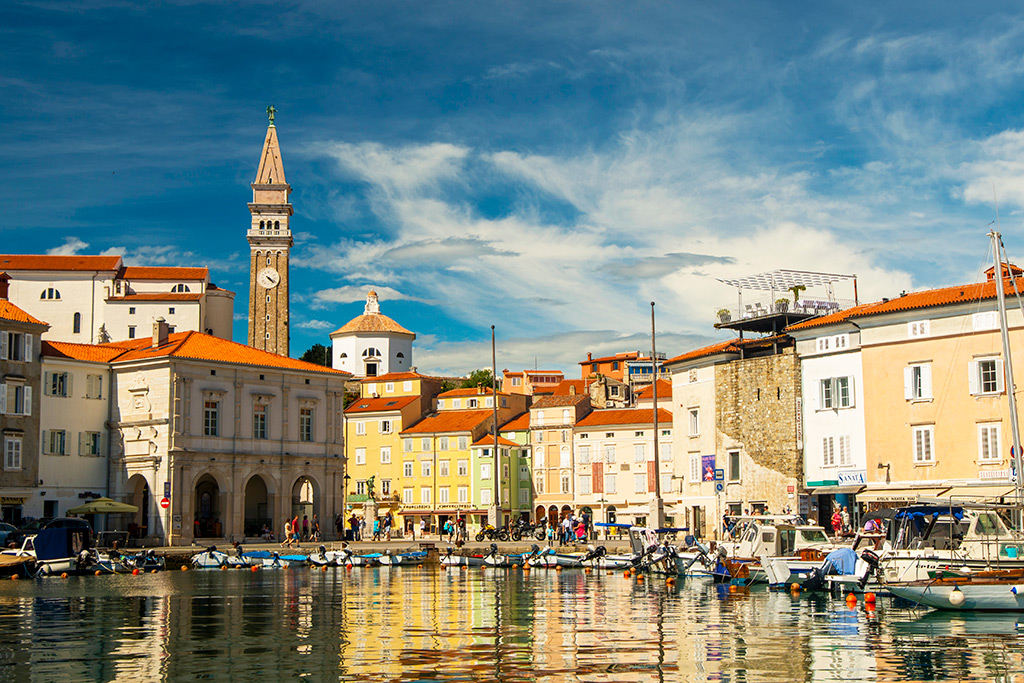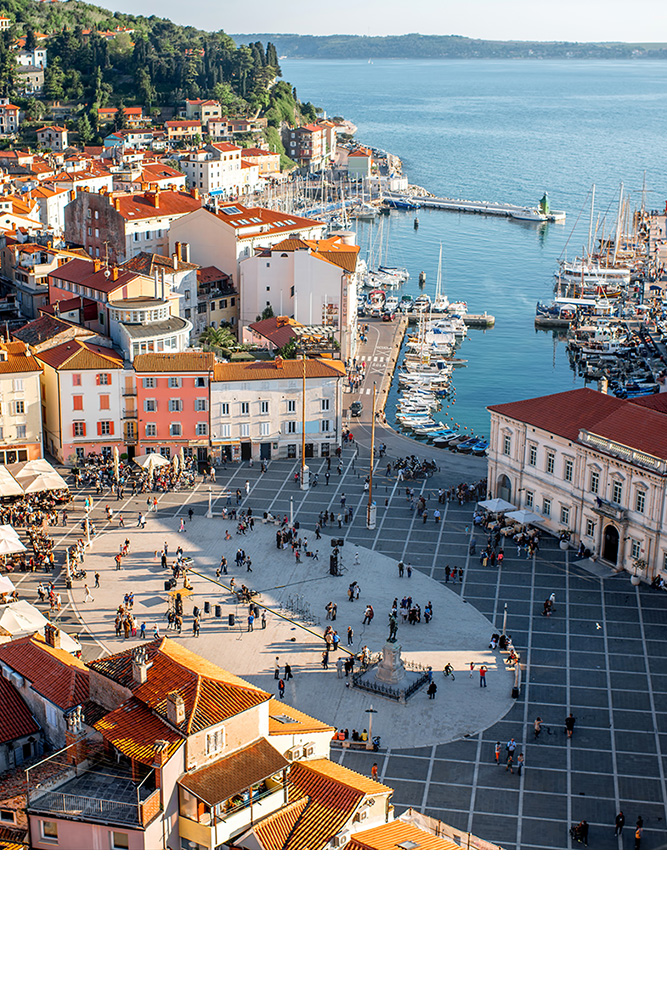

You’ve seen Tartini Square, climbed towards St George’s Church and walked along the waterfront. But some of Piran’s most memorable experiences are easier to miss. From hidden viewpoints and local swimming spots to tiny artisan shops, quiet corners and places that reveal another side of the town, here are 10 things we think are genuinely worth seeking out.
Some of Piran’s best discoveries begin when you stop trying to get somewhere. Leave the main routes around Tartini Square and the waterfront and follow whichever narrow street catches your eye. You’ll find laundry strung between windows, tiny courtyards, old stone doorways, forgotten chapels and sudden glimpses of the Adriatic.
There isn’t a particular route to follow — that’s the point.
Piran doesn’t really do beaches in the traditional sense — and that’s part of its charm. Walk beyond the busiest waterfront areas and you’ll find stone platforms, steps and rocky swimming spots where locals slip straight into the Adriatic. Bring water shoes, a towel and very little else.
Our tip: explore the coastline towards Fiesa or beyond Punta rather than looking for a conventional beach.
Most visitors photograph Piran from the Town Walls. We have another favourite. Follow Oljčna pot into the hills above town and Piran gradually reveals itself below you — the entire peninsula stretching from Punta Lighthouse to the historic walls, surrounded by the Adriatic.
It’s one of the most complete views of Piran and still surprisingly easy to miss.
Why it’s worth it: Fewer people, a beautiful walk and a perspective most day visitors never see.
Leave Piran on foot and follow the coastal path towards Fiesa. It’s an easy way to exchange Old Town streets for cliffs, Mediterranean vegetation and open Adriatic views without needing a car or planning a proper hike.
Take swimwear in summer — the walk is even better when it ends in the sea.
Before Tartini Square became the centre of Piran, life revolved around Prvomajski trg — the Old Square hidden among the narrow streets of the Punta district. Look closely at the large stone structure in its centre: built after a severe drought in the 18th century, it collected and filtered rainwater from the surrounding rooftops for the town.
Today, the square feels more intimate and lived-in than its famous neighbour, with restaurants, old façades and everyday life unfolding around the historic cistern. Film lovers have another reason to seek it out: in 2025 it became Slovenia’s first Treasure of European Film Culture.
Why it’s worth it: History hiding in plain sight — and a completely different atmosphere from Tartini Square.
Some of Piran’s best discoveries begin when you stop trying to get somewhere. Leave the main routes around Tartini Square and the waterfront and follow whichever narrow street catches your eye. You’ll find laundry strung between windows, tiny courtyards, old stone doorways, forgotten chapels and sudden glimpses of the Adriatic.
There isn’t a particular route to follow — that’s the point.
Piran doesn’t really do beaches in the traditional sense — and that’s part of its charm. Walk beyond the busiest waterfront areas and you’ll find stone platforms, steps and rocky swimming spots where locals slip straight into the Adriatic. Bring water shoes, a towel and very little else.
Our tip: explore the coastline towards Fiesa or beyond Punta rather than looking for a conventional beach.
Skip the generic souvenir stands and look for something with a connection to Piran and Istria. Nika’s Tiny House is worth seeking out for handmade pieces, Studio La Terra for coastal-inspired ceramics, while GourmIstra is our stop for olive oil, salt and other Istrian flavours you can actually enjoy once you’re home.
Just a few streets away from Piran’s busiest routes, the atmosphere can change completely. Step into the cloister of the Minorite Monastery for a moment of stillness, then seek out tiny Jewish Square, tucked almost invisibly into the Old Town.
Neither requires much time. That’s precisely why they’re so easy to walk past.
You may not associate Piran with dolphins, but bottlenose dolphins regularly inhabit the Gulf of Trieste. At the Morigenos Centre, you can learn about the animals researchers have been studying in these waters and the work being done to protect their marine environment.
It adds an unexpected layer to a day by the Adriatic — the sea around Piran isn’t just scenery, but a living ecosystem.
Piran’s walls get most of the attention, but traces of the fortified town continue deep into the streets below. Seven historic city gates still survive around Piran — and once you know what you’re looking for, finding them turns an ordinary walk through the Old Town into a small treasure hunt.
Look out for the 13th-century Muggia Gate, one of the oldest, and the beautifully preserved Gothic Dolfin Gate, built in 1483. Others appear almost unexpectedly between houses and narrow streets, reminders that medieval Piran was once enclosed behind layers of defensive walls.
Why it’s worth it: You start seeing Piran’s streets completely differently once you realise pieces of the medieval city are still woven into everyday life.
Local challenge: See how many of the seven surviving gates you can find without deliberately following a map.
Most visitors photograph Piran from the Town Walls. We have another favourite. Follow Oljčna pot into the hills above town and Piran gradually reveals itself below you — the entire peninsula stretching from Punta Lighthouse to the historic walls, surrounded by the Adriatic.
It’s one of the most complete views of Piran and still surprisingly easy to miss.
Why it’s worth it: Fewer people, a beautiful walk and a perspective most day visitors never see.
Everyone comes to Punta for the sea — especially at sunset — but the tip of Piran’s peninsula hides a much older story. Beside the lighthouse stands the Church of Our Lady of Health, first mentioned in the 13th century as the Church of St Clement, patron saint of sailors. It received its present name after a plague epidemic centuries later.
According to local legend, this part of the coast may even hold the story behind Piran’s name. Ancient sailors are said to have followed fires burning along the shore as navigational beacons — possibly connecting Piran with the Greek word pyr, meaning fire. Today, a lighthouse stands where those legendary fires are said to have guided ships across the Adriatic.
Why it’s worth it: Most visitors photograph Punta. Far fewer know what they’re actually standing beside.
From scenic walks and swimming spots to sunset viewpoints, restaurants and local food traditions, Piran rewards those who explore beyond the obvious. Our locally written guides offer practical tips, ready-made itineraries and first-hand recommendations to help you discover more of Piran and the Slovenian coast.

Discover Slovenia through Burja Hotels, a collection of distinctive stays in some of the country’s most memorable places. Stay among the historic streets of Ljubljana and Piran, wake up near Lake Bled, or slow down surrounded by nature in Bohinj — each property offers its own way to experience Slovenia.